
Mozart's lullaby: the lyrics, what they mean, and why it isn't by Mozart
November 25, 2026 · 5 min read
The lullaby known as Mozart's (Schlafe, mein Prinzchen): what the German words say, an English verse to sing with your child's name, the melody to listen to, and who really composed it.

"Mozart's lullaby" is a German lullaby from the late 18th century, "Schlafe, mein Prinzchen, schlaf ein": sleep, my little prince, go to sleep. For a long time it was credited to Mozart, but he didn't write it. Here are its lyrics, what they mean, an English verse to sing with your child's name, the melody to listen to, and its real story.
The lyrics of Mozart's lullaby
Here is how the first verse begins, in German:
Schlafe, mein Prinzchen, es ruhn Schäfchen und Vögelchen nun, Garten und Wiese verstummt, auch nicht ein Bienchen mehr summt.
Friedrich Wilhelm Gotter, for his play "Esther", published in 1795. The first of three verses.What the words mean
The first verse tells the little prince that everything around him is already asleep: the little lambs and the little birds are resting, the garden and the meadow have gone quiet, and not a single bee is buzzing anymore. Then the moon appears, peeking in through the window with its silver glow. The verse ends by asking the child to sleep in that silver light, and repeats "schlaf ein", go to sleep, like a sigh.
The next two verses talk about the sleeping castle, a maid who sighs, and a little prince spoiled with toys and sugar. They were written for the play, with a wink to the grown-ups, and are rarely sung to children.
An English verse, with their name
We wrote an English verse that follows the first German verse and falls right on the melody. Type your child's name, and choose princess or prince.
Sleep, my sweet princess, sleep, Lambs and birds have gone to sleep, The garden's hushed, the meadow's still, No bee is humming on the hill. The moon with her silver light Peeks through your window tonight. Sleep in the silver light, Sleep, Emma, my delight, Sleep tight, sleep tight.
Verse written by Un Amour d'Anime, to sing to the tune of the lullaby known as Mozart's.Why it isn't by Mozart
The words come from a play, "Esther", by the German writer Friedrich Wilhelm Gotter: a character, Fatme, sings it while playing the guitar. At least two composers set it to music in the late 18th century. In the 19th century, the version we sing today was credited to Mozart, and the official list of his works long numbered it K. 350.
Later, musicologists gave it back to Bernhard Flies, a Berlin doctor and amateur composer. Then, in 1988, two researchers, E. Goretzki and D. Krickenberg, concluded that an earlier melody had been published as early as 1796 by a young German composer, Friedrich Fleischmann, who had dedicated it to Gotter's daughters. Flies' version begins exactly like his. Today, that list of Mozart's works places it among the doubtful or wrongly attributed works.
Singing it at bedtime
It's a lullaby in six beats that sways gently: two rocks per bar. It starts high and comes down, like laying a baby down to sleep. Sing it slowly, and repeat the last line, "sleep tight, sleep tight", lower each time. For more ideas, see our lullaby lyrics with your baby's name and Brahms' Lullaby, which people often mix up with this one.
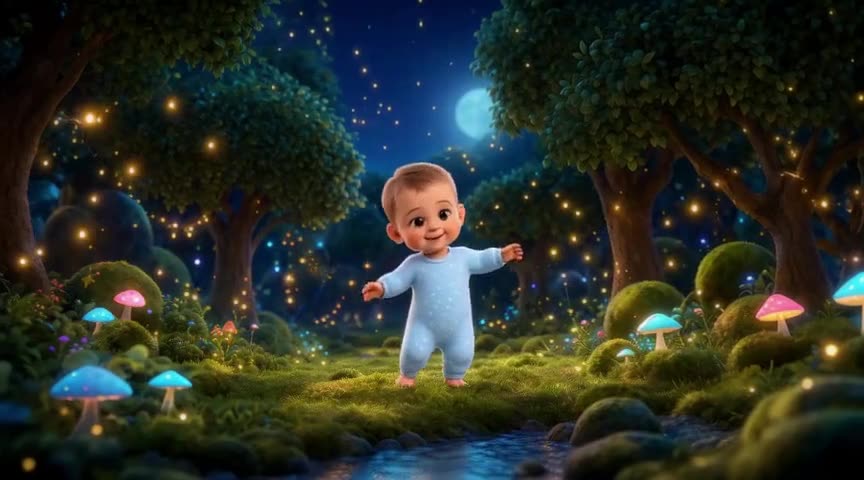
And if your child loves hearing their name in a song, our animated film Sleep tight, my treasure sings them a lullaby written just for them, with their name in every chorus, and it's your child, drawn from their photo, who falls asleep with their little companions.
Questions parents ask us
Who wrote Mozart's lullaby?
Not Mozart. The words are by Friedrich Wilhelm Gotter. The music is credited to Bernhard Flies, based on a melody published in 1796 by Friedrich Fleischmann.
What is it called in German?
"Schlafe, mein Prinzchen, schlaf ein", or simply "Wiegenlied", lullaby.
Mozart's lullaby or Brahms' Lullaby?
Two different tunes. Brahms', "Guten Abend, gut' Nacht", dates from 1868 and is the music box melody. The one known as Mozart's is about seventy years older.
Can you sing it to a little girl?
Of course: in our English verse, choose "princess", and her name comes in the eighth line.